

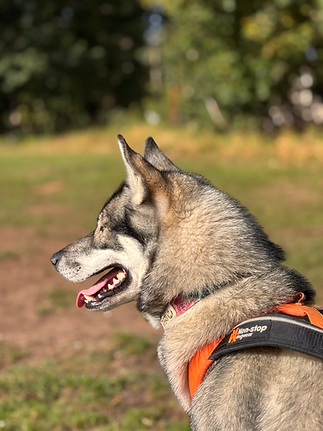
How to choose a harness for your dog
One of the most important pieces of canicross equipment is your dog's harness. A well-fitting harness allows your dog to move freely, pull comfortably and enjoy running without unnecessary pressure or restriction. A poorly fitting harness can reduce performance, cause rubbing, limit natural movement and, over time, contribute to discomfort or injury.
No single harness is perfect for every dog. Breed, body shape, coat type and running style all influence which design will provide the best fit. Whenever possible, it's worth having your dog professionally fitted before making a purchase.
Different types of harness
X-Back Harness
The X-back harness is one of the most recognisable canicross harnesses. It is designed for dogs that enjoy pulling consistently and works particularly well for many medium to large breeds.
The harness extends along the dog's body, distributing pulling forces from the chest through the body towards the tail. When correctly fitted, it provides excellent stability during running.
Freemotion-Style Harness
Freemotion-style harnesses are designed to encourage a natural running action while allowing excellent shoulder extension. The adjustable design makes them suitable for a wide range of breeds and body shapes, particularly dogs whose proportions don't suit a traditional X-back harness.
These harnesses are popular with both recreational runners and competitive athletes because they offer freedom of movement while maintaining efficient pulling mechanics.
H-Back and Adjustable Harnesses
Some dogs, particularly young dogs, rescue dogs or breeds with unusual body shapes, may benefit from an adjustable harness. These designs allow small adjustments around the body to achieve a more customised fit as the dog develops or changes condition.
What Does a Correctly Fitted Harness Look Like?
A harness should feel secure without being restrictive. It should stay in position while allowing your dog to move naturally through every stride.
Neck Fit
The neck opening should sit comfortably at the base of the neck rather than pressing against the throat.
A correctly fitted neck section:
-
Sits snugly without choking.
-
Doesn't slide up towards the ears during pulling.
-
Allows normal breathing and swallowing.
-
Doesn't create pressure on the windpipe.
-
The neck should feel supportive rather than tight.
Shoulder Movement
One of the most important areas to assess is shoulder freedom.
Your dog's shoulders should be able to extend fully as they run without the harness restricting movement. Watch your dog walk and trot naturally—there should be no shortening of their stride or rubbing behind the front legs.
If the harness restricts shoulder movement, your dog will often compensate by shortening their stride, reducing both comfort and efficiency.
Chest Fit
The front of the harness should sit centrally on the chest.
It should remain stable without twisting from side to side and should distribute pulling forces evenly across the front of the body.
Body Length
The body of the harness should finish before the last rib.
If the harness extends beyond the ribcage, it may place unnecessary pressure on the softer tissues of the abdomen rather than the ribcage, reducing comfort during exercise.
A harness that is too long may also become unstable while running.
Hip Position
The rear of the harness should never press down onto the hips or pelvis.
When your dog runs, their hips need to rotate freely. A harness that sits too far back can interfere with this movement, potentially affecting stride length and comfort.
Tail Position
The harness should not pull upwards on the base of the tail.
The rear attachment should sit comfortably without lifting or altering your dog's natural tail carriage.
Signs Your Harness May Not Fit Correctly
Your harness may need adjusting or replacing if you notice:
-
Rubbing or hair loss.
-
Restricted shoulder movement.
-
The harness twisting while running.
-
Pressure on the throat.
-
The harness moving up towards the ears.
-
The rear section extending beyond the last rib.
-
The harness sitting on or pressing into the hips.
-
Your dog appearing reluctant to pull or run.
Remember Every Dog Is Different
Two dogs of the same breed can require completely different harness sizes or even different harness designs. Factors such as chest depth, shoulder angle, body length and muscle development all influence which harness will provide the best fit.
A harness that works perfectly for one dog may not be the right choice for another.
Need Help Choosing?
At Canicross Coaching, we regularly help runners find the right equipment for both themselves and their dogs. If you're unsure which harness is most suitable or would like someone to check the fit of your existing kit, get in touch before you buy. A correctly fitted harness can make a huge difference to your dog's comfort, confidence and enjoyment on the trails.
We do not sell harnesses and equipment but can recommend retailers with extensive stock. We also can point you in the right direction if we can't find the right harness from our kit bag.
Canicross kit discount code: ANNEMARIEK9
click here to get discount off your canicross kit at K9 Trailtime
Contact
I'm always looking for new and exciting opportunities. Let's connect.
123-456-7890